


TL;DR
A prediction market is a platform where you buy and sell shares on the outcome of real-world events: elections, sports, tech, weather, culture. If you're right, your share pays out $1. If you're wrong, it's worth $0. The price of each share at any moment reflects the crowd's estimated probability that the event will happen. It's not betting: it's real-time information, produced by thousands of people putting their money where their mouth is.
"So... it's just gambling?"
It's the first question everyone asks. And the short answer is: no.
When you bet with a bookmaker, you're playing against the house. The house sets the odds, the house takes its margin, and the house always wins in the long run. You're alone against a system designed to take your money.
A prediction market is the opposite. There's no house. There are no odds set by anyone. There's you, and thousands of other people buying and selling shares based on what they actually think. The price forms naturally, exactly like a stock price on Wall Street.
The Wisdom of Crowds
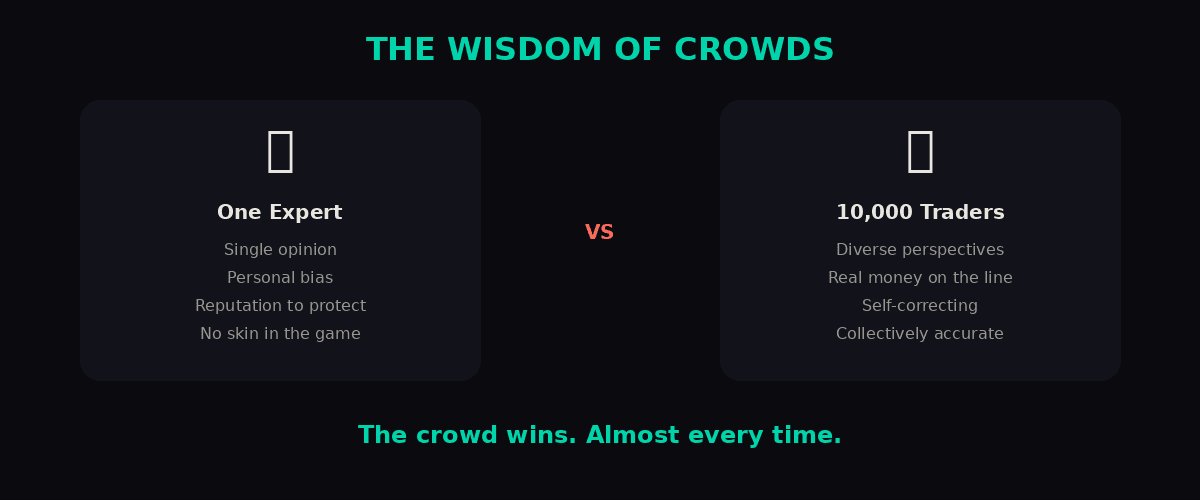
When you ask 10,000 people to estimate something, and each one has a financial incentive to be accurate, the average of their estimates is almost always more reliable than the best expert's opinion.
This isn't a theory. It's been proven time and again. In 2024, prediction markets were more accurate than polls for the US presidential election. More accurate than weather models on certain climate events. More accurate than Wall Street analysts on Federal Reserve decisions.

Today, CNN, Bloomberg, the Financial Times and university researchers cite prediction market prices as a source of information. Not because it's a game. Because it's the most reliable thermometer for what the world thinks is going to happen next.
How does a prediction market actually work?
The concept in one sentence
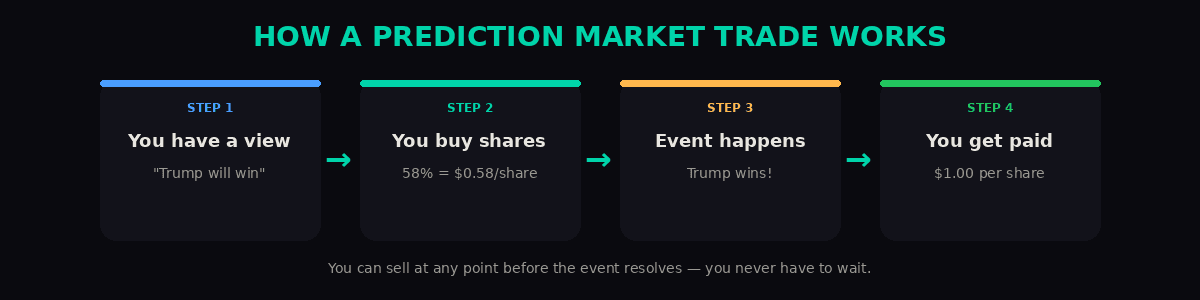
You buy a "Yes" or "No" share on a real event. If you're right, you get $1. If you're wrong, you get $0. That's it.
The link between probability and price
This is the key to understanding everything: the price of a share equals the crowd's estimated probability.
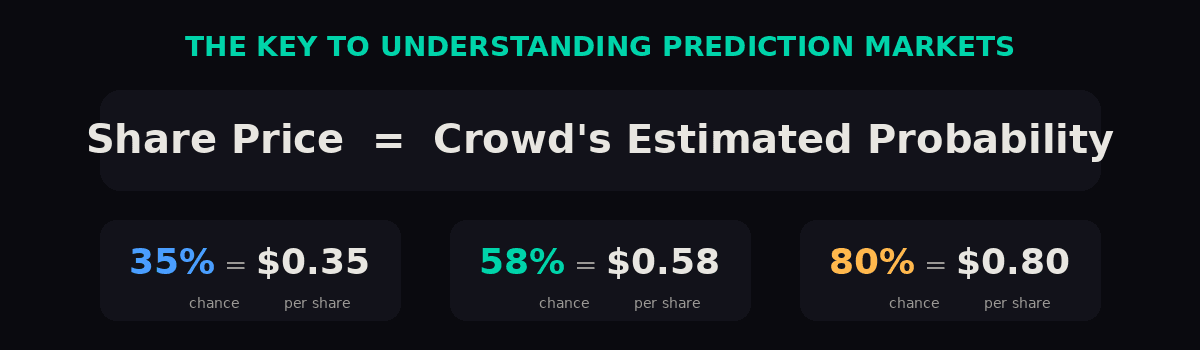
If the crowd thinks an event has a 35% chance of happening, the "Yes" share costs $0.35. If they think it's 80%, the share costs $0.80. The price and the probability are the same thing. Once you get that, you get prediction markets.
A real example: the 2024 US presidential election
The day before the vote, on November 4, 2024, the "Donald Trump wins the election" share was trading at $0.58 on Polymarket, meaning 58%. Traditional polls were calling it a coin flip. The market had a much sharper view.
You've been following the campaign, you've analyzed the swing states, and you agree with the market, maybe even more convinced. You buy 100 "Trump wins" shares at $0.58 each. Total cost: $58.
Scenario A: Trump wins (what happened). Each share is now worth $1. You receive $100. Profit: +$42.
Scenario B: Trump loses. Your shares are worth $0. You lose your $58.
Scenario C: You sell before the result. On election night, as results pour in state by state, the share jumps from $0.58 to over $0.98 in a matter of hours, before the media even officially calls the race. You sell your 100 shares for $98. Profit: +$40. And nobody has even said the word "victory" yet.
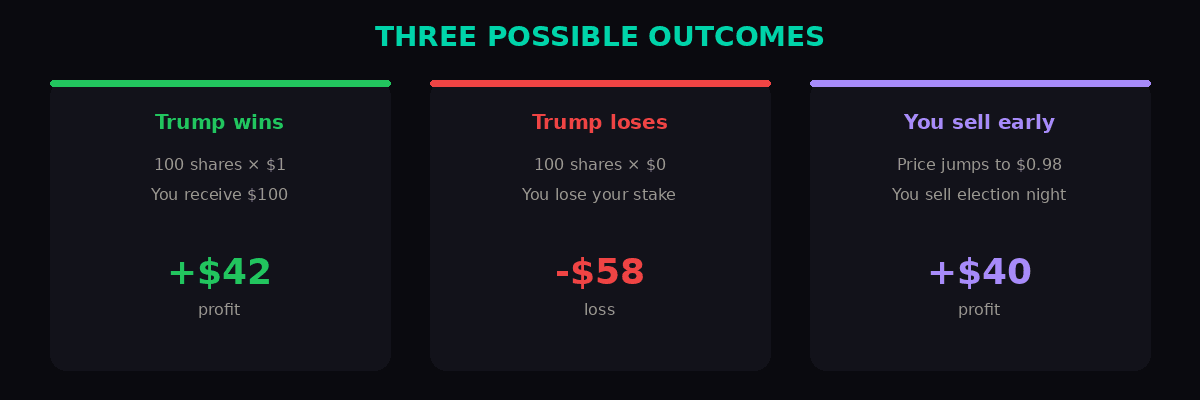
That's the beauty of the system: you never have to wait for the end. The market moves in real time with the news, the vote counts, the projections. Every price movement is an opportunity.
How a prediction market trade works, in 4 steps
What can you predict on a prediction market?
You're not limited to sports or elections. Anything with a verifiable outcome and a deadline can become a market. Here's what people are trading right now.
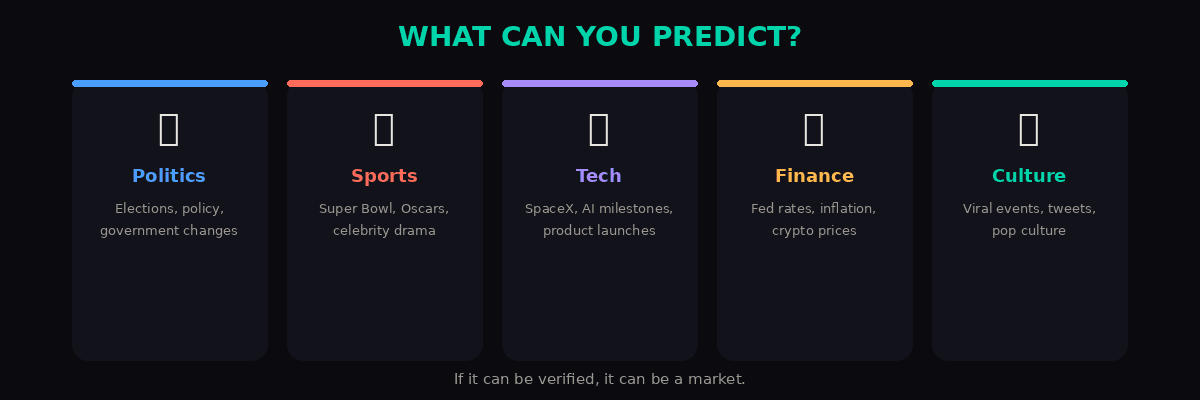
Politics & Elections
Who wins the next presidential race? Will a prime minister resign? The 2024 US election alone generated $3.7 billion in volume on Polymarket.
Sports & Entertainment
Super Bowl winner? Best Picture at the Oscars? Will Taylor Swift and Travis Kelce still be together by Christmas? Everyone has an opinion.
Tech & Science
Will SpaceX nail its next landing? Will Apple drop a foldable iPhone? Will AI break a specific benchmark before 2027?
Economy & Finance
Will the Fed cut rates? Will inflation drop below 3%? Will Bitcoin break $100K? Turn your macro analysis into a concrete position.
Culture & Viral Moments
How many times will Elon tweet this week? Will a specific event go viral? The fun category that proves anything measurable can be a market.
The common thread: a verifiable event, a deadline, a binary outcome (yes or no). If it can be checked, it can be a market.
How do people actually make money on prediction markets?
Method 1: Know something the crowd doesn't
The simplest case. You think an event has an 80% chance of happening, but the market has it priced at 55%. You buy at $0.55, and if you're right, you collect $1. Your edge is your analysis, your knowledge of a specific topic, your ability to spot what the majority hasn't priced in yet.
You don't need to be a finance expert. You need to be an expert in something. If you follow football closer than most, sports markets are your turf. If you're deep into US politics, election markets are your zone. The idea is to play where you have a real advantage.
Method 2: Buy low, sell high (without waiting for the result)
As we saw with the election example: you don't have to wait for the end. If you buy a share at $0.40 and a piece of news pushes the price to $0.65, you can sell immediately for a $0.25 profit per share. Pure trading, exactly like the stock market.
Method 3: Spot the crowd's obvious mistakes
Sometimes, the market gets it wrong. Not often, but it happens. An event is priced at 15% when the real probability is closer to 40%. This shows up when a market has low attention, when news just broke and the price hasn't caught up, or when emotional bias pushes the crowd in the wrong direction. These moments are rare, but when you find them, that's where the biggest profits happen.
What $10 can become
Buy 100 shares at $0.10 (10% probability). If the event happens, each share pays $1.
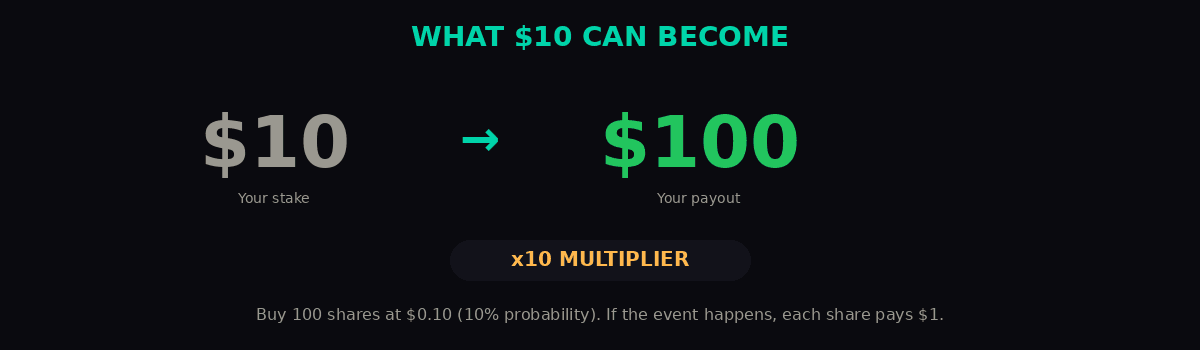
Obviously, there's only a 10% chance it happens. But that's exactly the kind of calculation you make on a prediction market: is the risk worth the potential payoff?
See today's markets on Polymarket
Is trading on prediction markets safe and legal?
No bookmaker, no shady middleman
On a prediction market like Polymarket, there's no "house" taking your money and deciding whether you win. The rules are written upfront, public, and executed automatically. Nobody can change the terms after the fact. Nobody can refuse to pay you if you're right. The system runs on guaranteed automatic rules (what the tech world calls "smart contracts"): computer code that executes exactly as intended, with zero human intervention.
Where are prediction markets legal in 2026?
The legal landscape is evolving fast. For a detailed breakdown, see our guide on whether Polymarket is legal. In the United States, the landscape has shifted dramatically. Kalshi operates as a CFTC-regulated exchange, legal in most states. Polymarket re-entered the US market in 2025 after acquiring QCEX, a CFTC-licensed derivatives exchange. Robinhood also launched prediction market trading in its app, powered largely by Kalshi. Some states (notably Nevada and New Jersey) are still pushing back on sports-related event contracts, but the federal trend is clearly towards broader acceptance.
In Europe, Asia, South America, and most of the world, there are no specific restrictions on trading prediction markets. The regulatory framework is evolving fast, and the global direction is towards more acceptance, not less.
Your money, your control
You deposit funds on the platform (via credit card, bank transfer, or crypto), you trade, and you withdraw whenever you want. No lock-up periods, no hidden fees. You see your positions in real time, you can sell at any moment. Full transparency: every order and every price is public.
For those wondering about fund safety: Polymarket operates on the blockchain, meaning every transaction is publicly verifiable. It's not an opaque bank account; it's an open ledger anyone can audit at any time.
Prediction markets vs. sports betting: what's the difference?
From the outside, it looks the same: you put money on an outcome, you win or lose. But once you dig in, the differences are massive.
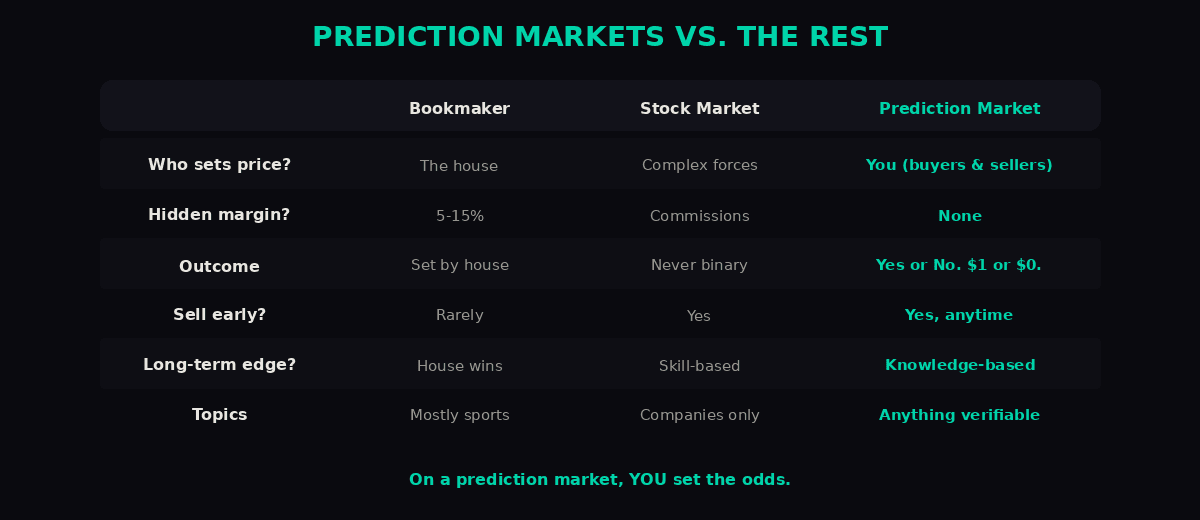
The key takeaway: on a prediction market, you set the odds. Not the house, not an algorithm, not a bookie. You and thousands of other participants, trading freely based on what you actually think is going to happen.
Why should you care about prediction markets even if you don't trade?
You don't need to put a single dollar in to benefit from prediction markets.
The best barometer in the world
When a share price moves, something is happening. Before the media publishes an article, before analysts give their take, the market price has already moved. Why? Because traders with early information act immediately: they buy or sell. The price reflects this new reality in real time.
In 2024, prediction markets signaled the pro-Trump momentum well before traditional polls budged. Journalists, financial analysts and university researchers now use Polymarket prices as a leading indicator, right alongside stock indexes and polling data.
"Financial markets are generally pretty efficient, and the evidence suggests that the same is true of prediction markets. There's no virtue-signaling in an anonymous market when you're betting."
: Eric Zitzewitz, Economics Professor at Dartmouth
Better than polls, every time
A poll asks 1,000 people what they think. Nothing stops them from lying, answering randomly, or changing their mind the next day. On a prediction market, every participant puts their own money on the line. When you risk your savings, you think seriously before taking a position. That's why prediction market prices are consistently more reliable than polls: people don't lie with their wallets.
A tool for the curious, journalists, and researchers
Want to know the real probability that the Fed will cut rates? Check the market. Want to know if traders take a merger rumor seriously? The price will tell you in one second. You don't need to trade. You just need to read.
How to start trading prediction markets in 2 minutes
Step 1: Create an account
The go-to platform is Polymarket: the world's largest prediction market, the most liquid (meaning the easiest to buy and sell quickly), and the one with the most active markets across every category. Signing up takes less than a minute.
Step 2: Deposit funds
Credit card, bank transfer, or crypto. It's as simple as paying for something online. No minimum required: start with $5 or $10 to test with zero pressure.
Step 3: Pick your first market
Browse the categories (politics, sports, tech, culture) and find a topic you actually know about. Your first trade should be on a subject where you have a real opinion, not something random. Look at the price, ask yourself "do I think the real probability is higher or lower?", and if you see a gap, go for it.
Step 4: Watch, learn, repeat
After your first trade, watch how the price evolves. Follow the news related to your market. See how events move the price in real time. That's when the switch flips: you'll never look at the news the same way again. Every piece of information becomes a question: "has the market priced this in yet?"
5 prediction market mistakes every beginner makes
We've all been there. Here are the classic traps that cost newcomers money.
#1: Trading a topic you know nothing about
You see a market with a low price, you think "looks like a deal", and you buy without understanding the subject. If you don't know why the price is where it is, you have no edge. You're flipping a coin, not trading. Golden rule: only trade where you know more than the average person.
#2: Going all-in on a single market
You're 100% sure something will happen. You throw your entire bankroll at it. The problem: even a 90% event fails one time out of ten. When that happens, you're wiped. Experienced traders never put more than 10 to 20% of their capital on a single market, even when they're very confident.
#3: Not reading the resolution rules
The most frustrating mistake. You think you've won, but the market resolves against you because you didn't read the exact conditions. Every market has specific rules: which source is authoritative? What's the exact deadline? What counts as a "win"? Always read the rules before buying. Always.
#4: Ignoring the timing
An event might have an 80% chance of happening, but if the share is already at $0.82, there's almost nothing to gain. The price already reflects the probability. Your potential profit is the gap between the current price and $1. If that gap is too small for the risk of losing your entire stake, the trade isn't worth it.
#5: Trading on emotions
You just lost a trade. You're frustrated. You want to "make it back" right now. So you jump into the first market you see. That's exactly how a small loss becomes a big one. The best traders have iron discipline: they accept losses, take a step back, and wait for the next real opportunity.
Ready to go deeper? Learn the frameworks used by profitable traders in our trading strategies guide and our guide to finding edge.
Prediction markets FAQ
Can I lose more than I put in?
No. Never. If you buy 100 shares at $0.58, your maximum risk is $58. That's it. No debt, no margin call, no nasty surprise. Your maximum loss is always your initial stake.
What happens if the event doesn't occur?
If you bought "Yes" shares and the answer turns out to be "No", your shares are worth $0. You lose your stake. If you had bought "No" shares instead, you'd receive $1 per share. It's binary: one side wins, the other loses.
Do I pay taxes on prediction market profits?
It depends on your country of residence. In most jurisdictions, prediction market gains are treated as capital gains or taxable income. In the US, platforms like Kalshi issue 1099-MISC forms listing net profits as ordinary income. Check your local legislation, or talk to an accountant if you're unsure.
What's the minimum amount to start?
There's no imposed minimum on Polymarket. You can start with $1, $5, or $10. Most platforms let you buy individual contracts for as little as a few cents. Start small, learn the mechanics, and scale up when you're comfortable.
What if the platform shuts down?
Polymarket runs on the blockchain. Your funds sit on a public, verifiable, decentralized ledger, not in some opaque corporate bank account. That doesn't mean the risk is zero (nothing is), but it's structurally more transparent than a traditional bookmaker. In 2025, Polymarket also acquired a CFTC-licensed exchange, adding a layer of regulatory legitimacy.
What's the difference between a "liquid" and "illiquid" market?
A liquid market has lots of buyers and sellers. You can buy and sell quickly, at the displayed price, with no friction. An illiquid market has few participants, meaning you might struggle to find a buyer when you want out. Stick to popular, high-volume markets when starting. The more trading activity, the better your experience.
The future is predictable (literally)
20 years ago, if you wanted to know what the world thought about the future, you read newspapers, listened to TV experts, or trusted the polls. All of these had one thing in common: nobody was held accountable when the prediction was wrong.
Prediction markets change that. Here, every opinion has a price. Every conviction is measured in dollars. And when thousands of people put their money on the line, the truth tends to emerge faster, more clearly, and more honestly than with any other method.
Whether you want to trade actively, follow the news from a completely new angle, or simply understand how the world evaluates the probability of future events, prediction markets are a powerful, accessible, and increasingly essential tool.
The best way to understand is to try it. Create an account, deposit a few dollars, and buy your first share on something you care about. You'll understand in five minutes what no article can explain.


